Nadi Dosha Cancellation — When Does It Actually Apply?
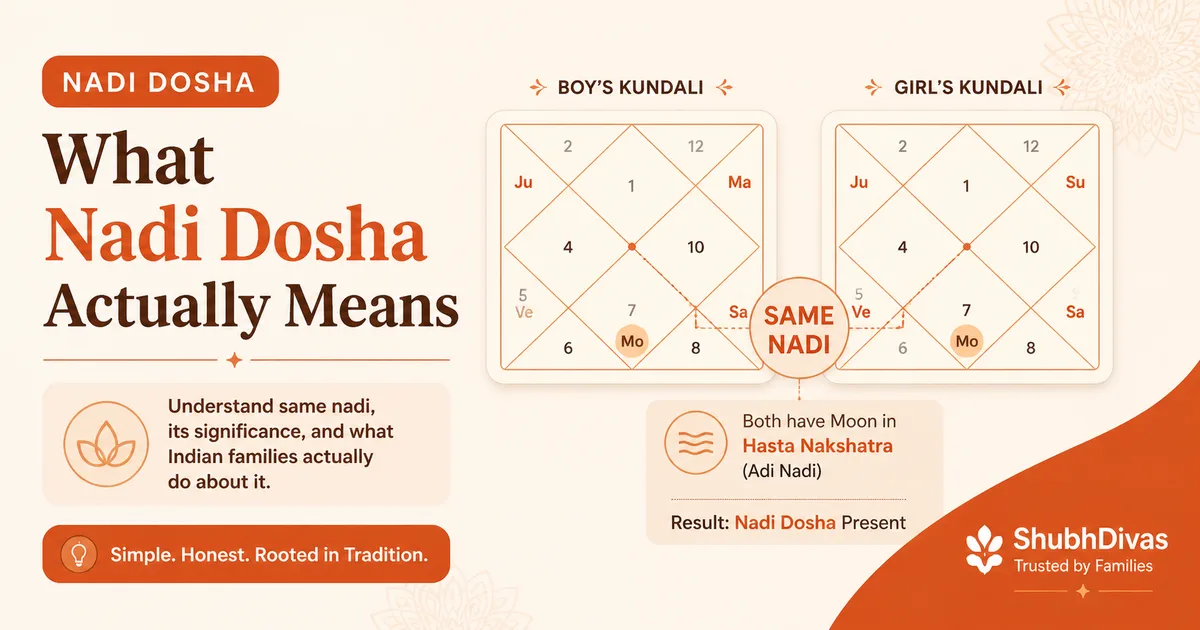
Nadi Dosha is the most heavily weighted factor in Ashtakoota kundali matching — it carries 8 out of 36 points. When both partners share the same Nadi (Adi, Madhya, or Antya), the score drops to zero and Nadi Dosha is said to be present.
Classical Vedic astrology, however, does not treat Nadi Dosha as absolute. Several well-documented conditions cancel or significantly reduce it. Understanding these conditions is essential before making any decision based on a Nadi Dosha flag.
What is Nadi Dosha?
The three Nadis divide the 27 nakshatras into three groups of nine:
Adi Nadi (Vata): Ashwini, Ardra, Punarvasu, Uttara Phalguni, Hasta, Jyeshtha, Moola, Shatabhisha, Purva Bhadrapada
Madhya Nadi (Pitta): Bharani, Mrigashira, Pushya, Purva Phalguni, Chitra, Anuradha, Purva Ashadha, Dhanishtha, Uttara Bhadrapada
Antya Nadi (Kapha): Kritika, Rohini, Ashlesha, Magha, Swati, Vishakha, Uttara Ashadha, Shravana, Revati
If both partners belong to the same Nadi group, Nadi Dosha is present. The traditional concern is incompatibility in health, progeny, and long-term harmony.
The Exact Cancellation Conditions
These are the conditions accepted across classical texts and widely followed by experienced Jyotishis:
Condition 1 — Same Nakshatra, Different Pada
This is the most important and most widely accepted cancellation.
If both partners share the same birth nakshatra but are born in different padas (quarters), Nadi Dosha is fully cancelled in most traditions.
Each nakshatra has 4 padas. A couple born in the same nakshatra — say, both in Rohini — but in Rohini Pada 1 and Rohini Pada 3 respectively, are considered to have cancelled Nadi Dosha.
Why this matters: Many couples who share the same nakshatra automatically have Nadi Dosha (same nakshatra = same Nadi). The pada distinction is what separates a problematic match from an acceptable one.
Condition 2 — Same Nakshatra, Different Rashi
In some nakshatra-rashi combinations, a single nakshatra spans two rashis. If both partners are born in the same nakshatra but their moon falls in different rashis, Nadi Dosha is considered cancelled.
This applies to nakshatras that straddle rashi boundaries — such as Krittika (Aries/Taurus), Mrigashira (Gemini/Taurus), Chitra (Virgo/Libra), Vishakha (Libra/Scorpio), and others.
Condition 3 — Same Rashi, Different Nakshatra
If both partners share the same moon sign (rashi) but are born in different nakshatras, Nadi Dosha is cancelled in many classical interpretations.
The logic here is that the rashi-based compatibility (Bhakoot Koot) overrides the nakshatra-based incompatibility when the rashis are the same.
Condition 4 — Same Nakshatra Lord
If the ruling planets of both partners' nakshatras are the same, some schools of Jyotish consider this sufficient to cancel or significantly reduce Nadi Dosha.
Each nakshatra is governed by one of nine planets (Ketu, Venus, Sun, Moon, Mars, Rahu, Jupiter, Saturn, Mercury) and this rulership repeats across the three sets of nine nakshatras. When both partners' nakshatra lords are identical, the energy is considered harmonious enough to offset the Nadi incompatibility.
Condition 5 — Same Rashi Lord
If both partners' moon signs are ruled by the same planet (e.g., both in Aries and Scorpio — both ruled by Mars in traditional Jyotish), some astrologers extend the same-lord logic to cancel Nadi Dosha.
This condition is less universally accepted than Conditions 1–3, but it is referenced in several regional astrological traditions.
Condition 6 — Exalted or Own-Sign Moon
If either partner's moon is in its own sign (Cancer) or exalted (Taurus), the overall strength of the moon chart is considered to significantly reduce the impact of Nadi Dosha.
A strong moon in the chart of one partner is viewed as a protective factor for the relationship's long-term health and progeny concerns.
When Cancellation Does NOT Apply
It is important to be equally clear about when the dosha is not cancelled:
- If both partners share the same nakshatra AND the same pada — Nadi Dosha is generally not cancelled and the match requires careful consideration
- If there is no cancellation condition present and the Nadi Dosha is accompanied by Bhakoot Dosha — the combined doshas need a thorough chart analysis
- Cancellation conditions apply to Nadi Koot specifically — they do not automatically fix other compatibility issues in the chart
What to Do If Nadi Dosha is Present
Step 1 — Verify the cancellation conditions above. Check the exact nakshatra and pada of both partners. Many Nadi Dosha flags dissolve at this step.
Step 2 — Check the full chart. A strong Jupiter, strong 5th house (progeny), and strong 7th house in both charts significantly reduce the practical concern of Nadi Dosha.
Step 3 — Consider Nadi Dosha Nivaran puja. A traditional remedial puja specifically for Nadi Dosha is widely practiced and accepted across Hindu traditions. Many families perform this as a precaution even when the dosha appears mild.
Step 4 — Consult a qualified Jyotishi. The interaction of Nadi Dosha with the full chart — dashas, individual chart strengths, and other compatibility factors — is something only a complete chart analysis can address.
Run your kundali compatibility check on ShubhDivas to see your complete Ashtakoota breakdown, including your exact Nadi Koot score and whether any cancellation conditions apply to your match.