Kundali Matching for Love Marriage — An Honest Guide
If you are in a love relationship and considering marriage, you may be asking a question that millions of Indian couples ask every year: does kundali matching still matter when you have already chosen each other?
The honest answer is: yes — but the purpose is different from an arranged marriage.
In an arranged marriage, kundali matching helps assess compatibility before two strangers commit. In a love marriage, you already know you are compatible in many ways. The kundali check serves a different function — it helps you understand the specific areas where you may face friction, and gives your families a point of reference for their concerns.
Here is how to use it wisely.
Why Couples in Love Marriages Still Check Kundali
For family acceptance: In many Indian families, a kundali compatibility check is a prerequisite for family approval — even in love marriages. A good score, or a clear explanation of why a lower score is not concerning, can go a long way in addressing family hesitation. Having the full report to share gives the conversation a factual basis.
For self-awareness: Even couples who know each other well benefit from understanding which areas of their relationship may need more attention. A low Gana Koot score, for example, indicates a potential temperament mismatch — something worth being aware of and discussing openly.
For the doshas: If Nadi Dosha or Mangal Dosha is present, knowing it early means you can perform the recommended remedies before the wedding rather than discovering it later. This is practical, not superstitious.
For peace of mind: Many couples simply want to know. A clear, well-explained compatibility report removes uncertainty and allows both partners to enter the marriage with full awareness.
What the Guna Score Means — and Does Not Mean
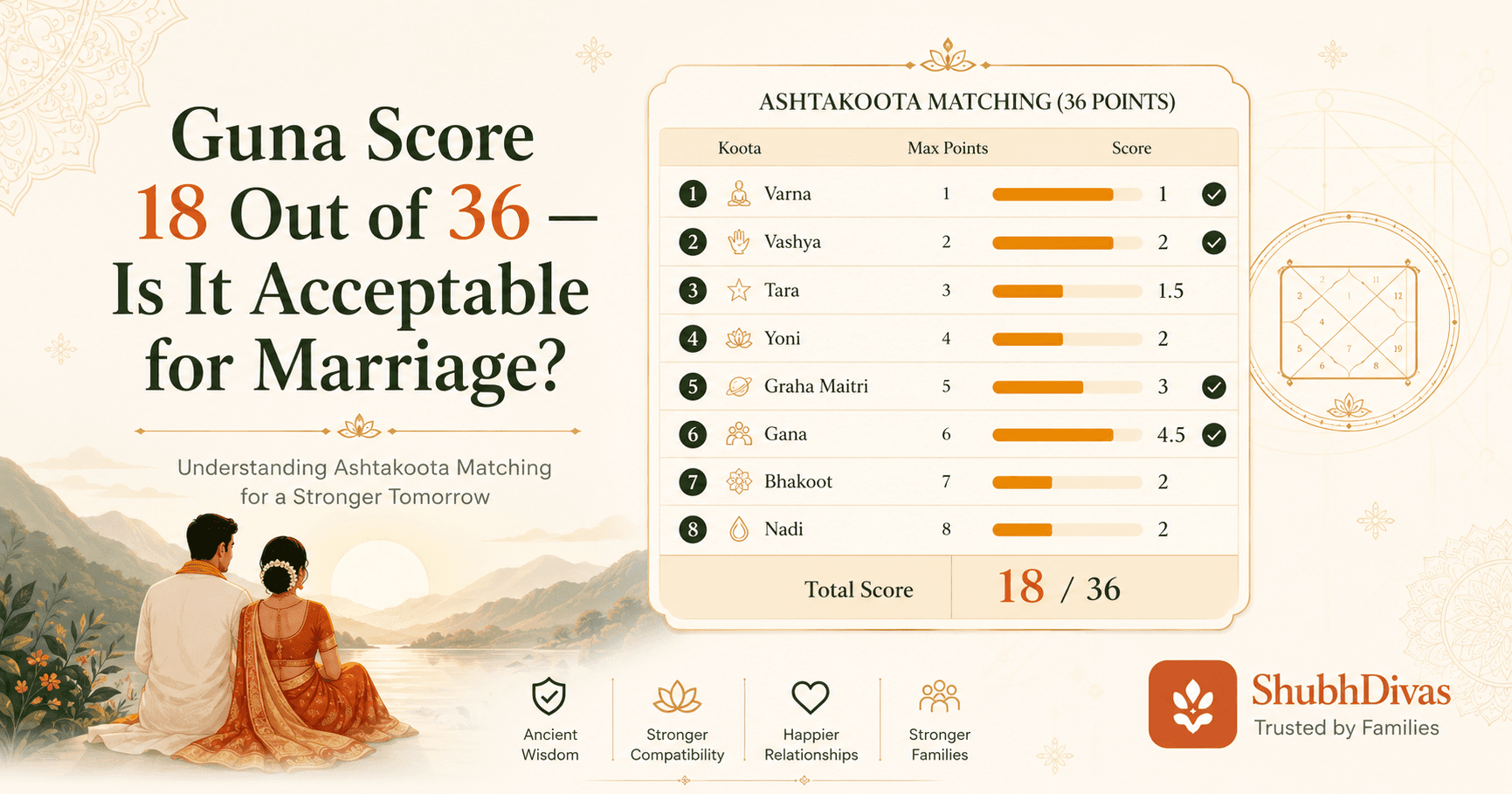
The Ashtakoota system assigns up to 36 points across 8 categories. For love marriages, the score should be understood as a map, not a verdict.
A high score (24+) does not guarantee a happy marriage. Compatibility on paper does not replace real-world understanding, communication, and mutual respect — things a love couple has already demonstrated.
A low score (below 18) does not mean you should not marry. Many love marriages with scores below 18 are deeply happy. The score reflects astrological compatibility patterns, not the lived reality of your relationship.
The score is most useful when you examine it by category. A score of 20 where Nadi and Bhakoot are both strong is very different from a score of 20 where they are both zero. The breakdown matters far more than the total.
The Three Things to Actually Focus On
For a love marriage, experienced Jyotishis typically focus on three things rather than the total score:
1. Major doshas Is Nadi Dosha present? Is Mangal Dosha present in either chart? These are the two factors most worth checking and, if present, most worth addressing with remedies before the wedding.
2. 7th house and Venus in both charts The 7th house governs marriage. A strong 7th house and well-placed Venus in both charts is a positive sign regardless of the guna score. A weak 7th house in either chart deserves attention.
3. Dasha at time of marriage What planetary period (dasha) is each partner running at the time of the wedding? Getting married during Jupiter dasha, Venus dasha, or the dasha of a well-placed planet in your chart is considered auspicious. A challenging dasha at the time of marriage is worth discussing with an astrologer.
Addressing Family Concerns
The most common situation in love marriages is: you are certain, your family is uncertain. Here is how kundali matching can help bridge that gap.
If the score is good (24+): Share the full report with the family. A strong score provides objective reassurance that the match is astrologically sound.
If the score is moderate (18–24): Explain the koota breakdown. If Nadi and Bhakoot are strong and the lower scores come from minor kootas, a qualified astrologer can explain this to the family directly. Many families become comfortable once they understand which factors are strong.
If the score is low (below 18): Do not hide it — families often find out anyway, and concealment damages trust. Instead, have a complete chart analysis done by a respected Jyotishi. A personal, thorough assessment by a trusted astrologer carries far more weight with families than a software report.
If major doshas are present: Recommend performing the relevant remedies (Nadi puja, Kumbh Vivah for Mangal Dosha). Many families are satisfied when they see that the dosha has been acknowledged and addressed properly.
Inter-Caste and Inter-Religion Love Marriages
Kundali matching is rooted in Hindu Vedic tradition. For couples from different religious or cultural backgrounds, the question of compatibility is best approached through open conversation rather than a system that may not apply equally to both partners.
For inter-caste Hindu marriages, the kundali check applies normally — caste is not a factor in the astrological compatibility calculation itself. The Ashtakoota system evaluates nakshatra and rashi-based factors, not caste or community.
A Grounded Perspective
You chose your partner by living life together — through conversations, shared experiences, and the kind of understanding that no birth chart can fully capture. That is real and it matters.
Kundali matching is a traditional tool that offers a complementary perspective. Use it as information, not instruction. Take seriously what feels relevant to you, seek remedies for any significant doshas, and approach any concerns with curiosity rather than fear.
Check your kundali compatibility on ShubhDivas to get the full Ashtakoota breakdown, dosha analysis, and a clear picture of your match.